Fall 2020 Books

Every three months I plan to post a list of books I’ve read over that period. One reason for doing this is to remember better the books I’ve read. In a world of many shiny things to get distracted by, knowing that I plan to write a paragraph and pick a quote helps me read with additional focus. I also hope that others might find this useful in deciding what they want to read next and that correspondingly I get suggestions for new books based on my reactions to this crop.
The format is a single-paragraph personal summary and reaction. I’ll also pick one quote from the book that captures a main takeaway for me. I’m intentionally not doing a numeric “star” rating as I feel that it’s impossible to give a book its due this way. The list is in reverse chronological order (starting with most recently read).
Fall 2020 Books
1) The Ministry for the Future: A Novel by Kim Stanley Robinson. Named after a fictitious UN agency whose responsibility is to advocate for future generations. This “cli-fi” book is not structured like a novel; rather, it’s a collection of vignettes alternating between the ravages of climate change to more hopeful stories of the world’s governments and grassroots groups working on a solution that ultimately does bend the (Keeling) curve. Blurs the line between fiction and a policy think piece, as almost all of the technologies and groups mentioned are near-term extrapolations from today: a global coin offering by central banks; mass human displacement; extreme-temperature events; frighteningly accessible drone warfare; the Half-Earth Project, the 2000-Watt Society, and the five-page chapter 85 that is simply a well-researched list of real environmental organizations from around the world. It was great to see conservation as part of the narrative, from wildlife highway crossings to the Gulo gulo bouncing back.
One quote: “‘We know we all live in a village of eight billion neighbors. That’s our now.’”
2) Factfulness: Ten Reasons We’re Wrong About the World—and Why Things Are Better Than You Think by Hans Rosling. Eye-opening book that made me realize that I have a 1980s view of how “developed” the world is. Turns out a lot has changed—for the better—since the ’80s. The book starts out with an interesting quiz to measure your knowledge of health, education, and wealth across the world. It follows by giving 10 useful tools to help understand the world better and improve your quiz score.
One quote: “When we have a fact-based worldview, we can see that the world is not as bad as it seems—and we can see what we have to do to keep making it better.”
3) Raven’s Witness: The Alaska Life of Richard K. Nelson by Hank Lentfer (edited by Elizabeth Johnson). Biography of a unique 20th-century Alaskan. Richard K. Nelson listened (deeply listened) to the Native people, animals, and landscapes of his adopted state. The result is a legacy of writing, lectures, and radio shows that capture his world in a much more intimate way than if he had pursued a more academic path after obtaining his anthropology PhD. This book introduced me to Nelson’s writing and left me wanting to read more of it.
One quote: “’The fact that Westerners identify this remote country as wilderness reflects their inability to conceive of occupying and utilizing an environment without fundamentally altering its natural state.’”
4) Barbarian Days: A Surfing Life by William Finnegan. Pulitzer Prize–winning biography by a surfing-obsessed staff writer for the New Yorker. Every part of his life story was compelling: from wandering the globe as a 20-something putting off adulthood to becoming a war correspondent who at 60 years old still can’t get enough surfing. The vivid descriptions of surf spots in every ocean and the euphoria of riding a wave are great, but even better are the interesting people met and lifelong friendships made through shared passion for the outdoors.
One quote: “I liked surrendering to the onrush, the uncertainty, the serendipity of the road.”
5) To the Bright Edge of the World by Eowyn Ivey. A beautifully written fictional account of an 1800s exploration traversing the Wolverine River in Alaska and intersecting with Native people. I once heard Andrew Skurka describe Alaska’s Brooks Range as an intensely wild place that more than anywhere he’d ever been made him feel like just another species on the landscape. I was reminded of his story as I read this surreal book, where Ivey masterfully captures “modern” people entering a world where there is a very thin line between human and nonhuman.
One quote: “Never are the people here allowed to forget that each of us is alive only by a small thread.”
6) Leave It As It Is: A Journey Through Theodore Roosevelt’s American Wilderness by David Gessner. Through a 2018 road trip around the West, this book chronicles Theodore Roosevelt’s public lands legacy. This format yields a very accessible account of TR’s place at the forefront of the conservation movement—the title comes from a famous TR speech at the Grand Canyon. Within this context, Gessner presents the modern fight for public land, including protecting Bears Ears in Utah.
One quote: “As well as creating five national parks and eighteen national monuments, he set aside fifty-one federal bird reserves and four national game preserves, and of course created the United States Forest Service and one hundred and fifty national forests.”
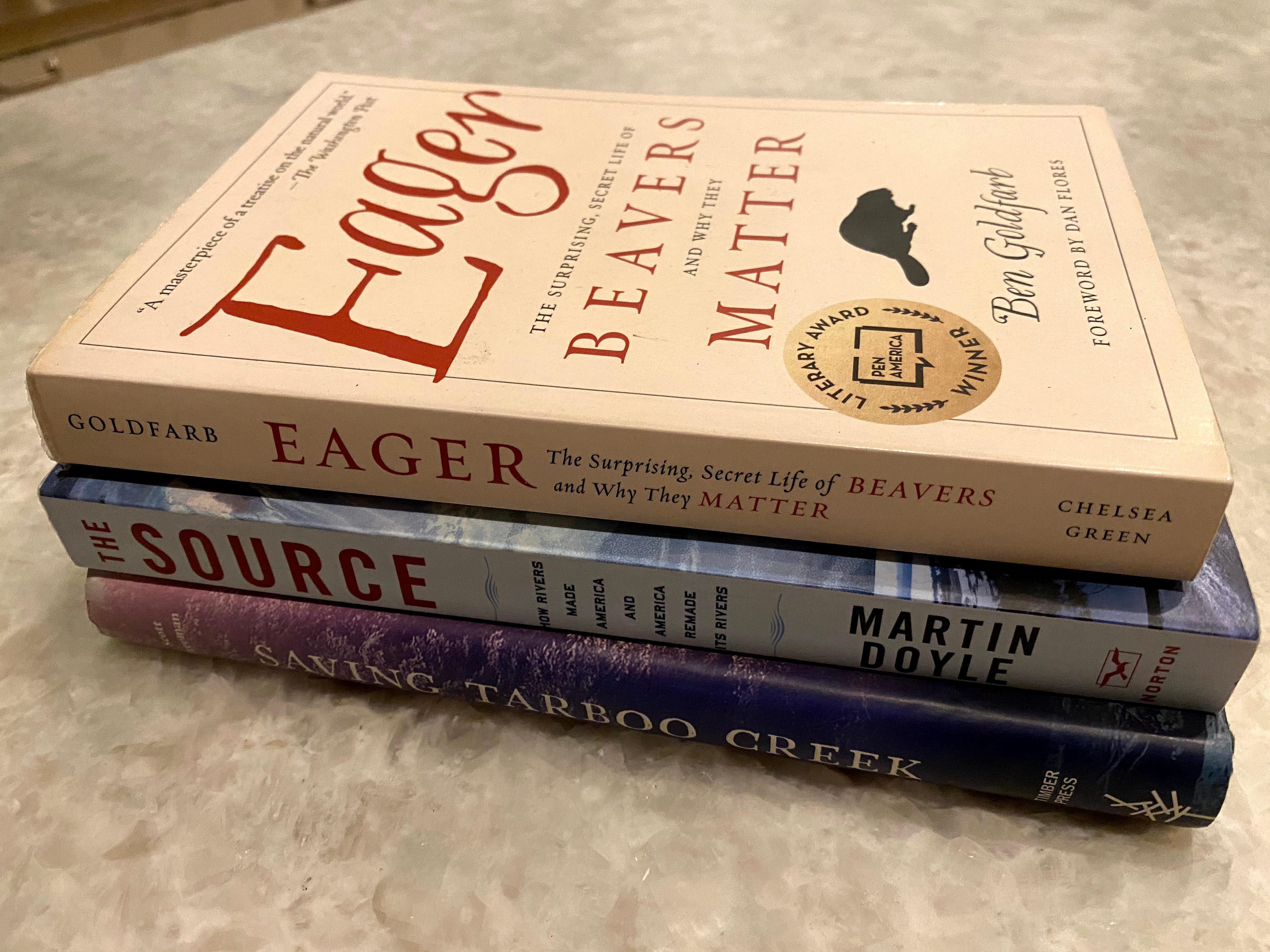
7) The Source: How Rivers Made America and America Remade Its Rivers by Martin Doyle. This was a packed survey of how rivers have impacted American history. A few of the interesting things that I learned: why the Erie Canal was the most viable way to open the West, how the Mississippi was “straightened,” how the policies behind levees in New Orleans contributed to the Hurricane Katrina breeches, and the science of why a river meanders. Because rivers, like most of our natural resources, have been overdeveloped, the book ends by highlighting the resulting burgeoning restoration economy. A fun thread for me running through this and my previous two books is Aldo Leopold and beavers. Both show up in all three by contributing to the healing of our precious flowing waterways.
One quote: “[I]n 2000, the Corps of Engineers estimated that the nation has over 80,000 dams more than ten feet tall. By that estimate, Americans have been building on average one dam per day since the signing of the Declaration of Independence.”
8) Saving Tarboo Creek: One Family’s Quest to Heal the Land by Scott Freeman. While today we hear about the massive deforestation happening globally (like in the Amazon), this book is a reminder that we in the US have our own long history of unsustainably exploiting nature. Here, a Seattle family adopts a damaged plot of land on the Olympic Peninsula, including a stream that had become little more than a drainage ditch. Replanting the forest and re-meandering the stream yields results like improved salmon runs and attracting beaver back, but also turns out immensely satisfying for the family as they learn what it means to live “a natural life.”
One quote: “Throughout history, people have used forests, wildlife, water, and soil until they were used up. When that day arrived, the individuals who were affected either died or moved.”
9) Eager: The Surprising, Secret Life of Beavers and Why They Matter by Ben Goldfarb. It’s not surprising how many awards this book won—the writing flows and is very engaging. The beaver, it turns out, is one the world’s most impactful mammals. European expansion across North America was first driven by trappers going after the beaver’s dense pelt, and much of the continent was shaped through beaver dams holding water on the land. The author does a great job weaving solid research with stories of interesting individual beaver fans who today are working to restore this rodent to the benefit of the landscape. Goldfarb has also become one of my favorite new follows on Twitter.
One quote: “[B]eavers once submerged 234,000 square miles of North America—an area larger than Nevada and Arizona put together.”